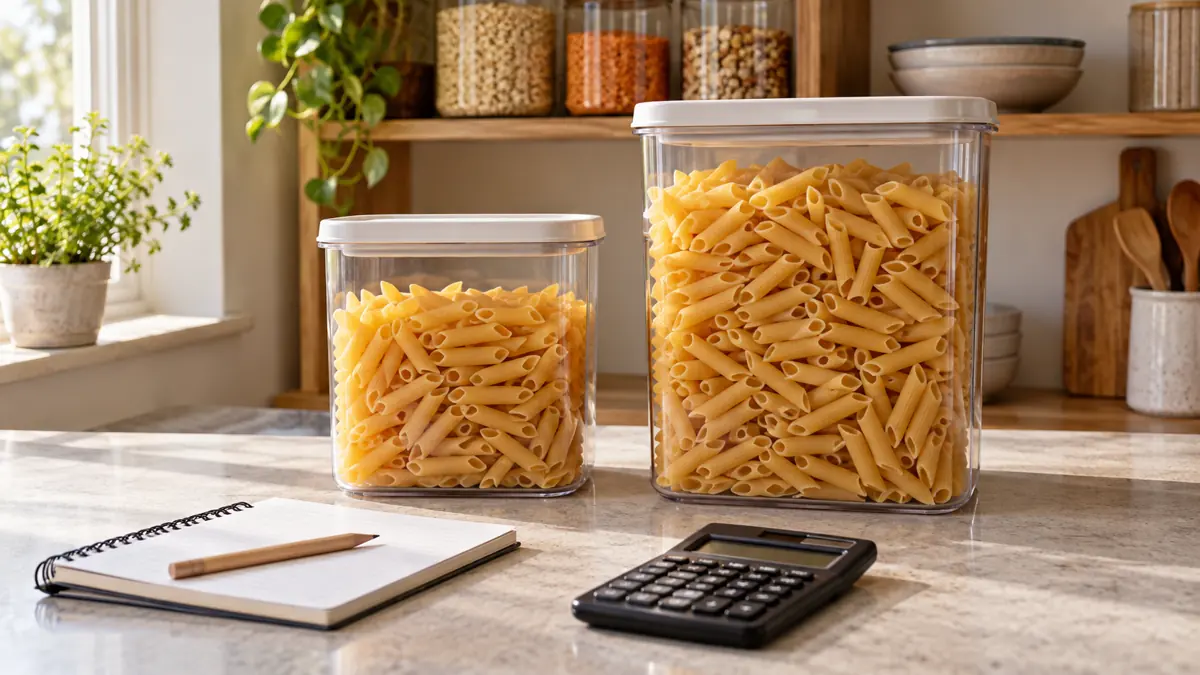
A bigger package can have the lower shelf price per ounce and still cost you more for what you actually use. The missing number is the usable quantity: how much of the purchase your household will consume before it is wasted, forgotten or no longer wanted.
Quick answer: Compare both the unit price and the cost per usable unit. Then check the total checkout amount against your grocery budget. A low unit price is helpful only when the product, quantity and timing fit your household.
Reviewed October 29, 2026. Every price and quantity in the examples is hypothetical, not a current store offer or a national average.
Start with a fair unit-price comparison
Unit price = package price ÷ package quantity. Use the same measurement on both sides: dollars per ounce, per pound, per count or per load. Do not compare dollars per pound with dollars per ounce without converting. For a simple weight comparison, one pound equals 16 ounces.
NIST explains unit pricing as a way to compare product value across package sizes. The shelf label is a starting point; check that the measurements and the actual package size match.
Compare products that serve the same purpose. A concentrated detergent and a regular detergent may need a cost-per-recommended-load comparison rather than a bottle-size comparison. For food, different forms or preparation requirements can make weight alone misleading. Use the quantity that represents the result you need, and follow product instructions.
Example: a lower shelf price loses after waste
| Option | Package price | Quantity | Shelf price per ounce |
|---|---|---|---|
| Small package | $4.80 | 16 oz | $0.30 |
| Bulk package | $12.00 | 48 oz | $0.25 |
The bulk option is about 16.7% cheaper per ounce at the shelf: ($0.30 − $0.25) ÷ $0.30. But that saving assumes the purchased quantity becomes useful consumption. If you use all 16 ounces of the small package and only 36 ounces of the large package, the comparison changes.
| Option | Usable quantity | Cost per usable ounce |
|---|---|---|
| Small, all used | 16 oz | $4.80 ÷ 16 = $0.30 |
| Bulk, 75% used | 36 oz | $12.00 ÷ 36 ≈ $0.333 |
| Bulk, all used | 48 oz | $12.00 ÷ 48 = $0.25 |
At 75% usage, the large package costs roughly 33.3 cents per ounce actually used, compared with 30 cents for the small package. Buying more has not saved money in this scenario. This is a planning estimate: the small package can have waste too, so estimate usable quantities for both options honestly.
Find the minimum amount you must use
Required usable quantity to match the smaller option = bulk price ÷ smaller option’s cost per usable unit. In this example, $12 ÷ $0.30 = 40 ounces. Using 40 ounces ties the smaller package; using more than 40 makes the bulk package cheaper per usable ounce.
The break-even usable share is 40 ÷ 48 = 83.3%. You therefore need to use more than roughly 83.3% of the bulk package to beat the small option under these assumptions. If extra costs apply, add them before calculating the threshold.
A useful cross-check is the maximum saving. Using all 48 ounces costs $12 in bulk versus $14.40 at the small package’s $0.30 rate. The most this specific comparison saves is $2.40 before tax differences and other costs. A special trip costing more than that would erase the advantage even with no waste.
Count the extra costs that the shelf label leaves out
Include incremental delivery charges, extra travel, required storage purchases or membership costs caused by the buying decision. Do not allocate an entire existing annual membership fee to one purchase if you would pay it anyway; for a new membership, evaluate total expected savings across realistic purchases.
For that broader decision, our membership break-even calculator helps compare a fee with expected savings. Keep the assumptions conservative and avoid counting the same saving twice.
Use an all-in version of the formula when necessary: usable cost = (package price + incremental costs − certain discounts) ÷ usable quantity. A coupon you cannot redeem or a rebate you may never receive is not the same as a guaranteed checkout reduction. Separate uncertain rewards from the base comparison.
Check the checkout total, not just the annual saving
The small package requires $4.80 today; bulk requires $12. That is an additional $7.20 tied up in one item. Even a good long-run price can be a poor choice if it leaves too little for this week’s meals, transit or a bill due before payday.
Put bulk purchases inside your monthly grocery budget and track the actual cash paid in the shopping week. Do not treat a multi-month supply as free in later months while also forgetting the large initial payment.
For toiletries and cleaning products, use our household supplies budget to distinguish the monthly consumption estimate from the restocking checkout amount. A product may last several months while the money leaves your account all at once.
Estimate usage from your own cupboard
Look at the last one or two purchase cycles. How long did the item last? Was any discarded? Did a sale change how much you used? Estimate your normal consumption rather than the amount you hope to use because a large package is on offer.
Before buying, check existing stock, available storage, the manufacturer’s storage instructions and whether your household actually likes the product. A familiar staple is easier to estimate than an unfamiliar flavor or a product you have never tried. For food storage and safety, use the product label and appropriate official guidance; this price worksheet does not establish a safe storage period.
Splitting a package with someone can reduce excess quantity, but agree on the split and payment beforehand. Recalculate your own portion’s price, any travel cost and the quantity you will receive. An informal plan that never happens should not be the basis for the purchase.
A reusable five-question shopping test
Before choosing the large package, answer these questions: Are the units comparable? How much will I really use? What usable share is needed to break even? Are there additional costs? Can I afford the checkout amount without disrupting the rest of my budget?
If any answer is uncertain, run a cautious scenario. For example, compare using all, three-quarters and half of the package. Choose the small package when the claimed saving depends on unusually optimistic consumption. You can revisit the decision after measuring actual use.
Common questions
Is bulk always cheaper? No. Promotional pricing, different package sizes and waste can change the result. Calculate the actual unit prices on the day you shop.
Should I count tax? Compare the actual amount you will pay when tax treatment differs or materially changes the decision. Use consistent assumptions rather than mixing an after-tax price with a before-tax price.
What if both packages have waste? Divide each package’s all-in cost by its own usable quantity. The smaller package is not automatically waste-free.
Is a bigger package bad for a one-person household? Not necessarily. Actual consumption, storage and cash availability matter more than household size alone.
How often should I recalculate? When price, package size, usage or extra costs change. Keep a short note of quantity and price for frequently purchased items so the next comparison is easier.
Leave a Reply