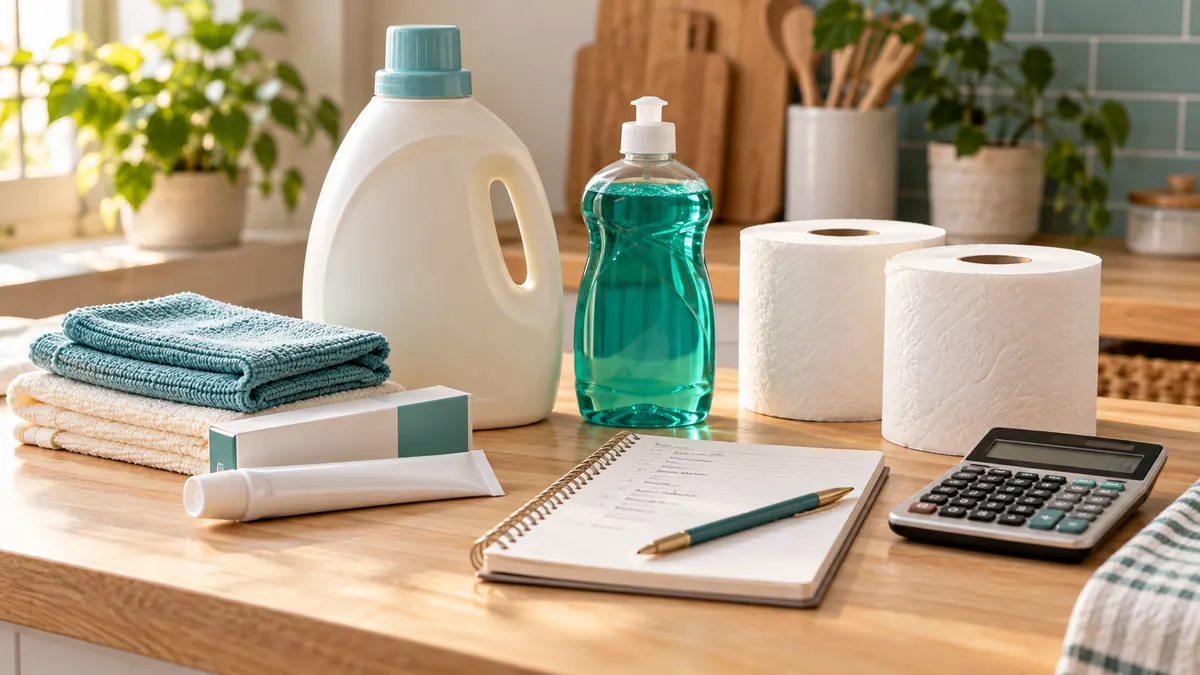
To estimate toiletries cost per month for one person, add each product’s price divided by how many months it lasts. The five-item example below costs $26 to buy and works out to $12 per month of use. That is an incomplete, hypothetical basket—not a U.S. average or a recommended spending limit. Add your own essential items and actual prices.
For a broader household supplies budget, keep toiletries separate from paper products, laundry and cleaning costs. This guide uses $60 monthly for one adult, $90 for two adults, and $150 for a four-person household. These are invented example budgets—not U.S. averages, minimum requirements, or claims that every household can meet its needs at those prices. Local prices, accessibility, preferences, and care needs can change the result substantially.
Toiletries cost per month for one person: a worked example
To estimate toiletries cost per month for one person, divide the price of each product by the number of months it lasts, then add the results. In the hypothetical basket below, the monthly equivalent is $12. This is the toiletries line inside the $60 one-adult household-supplies example, not another $12 to add to it. It is not a measured average or a claim that $12 covers everyone’s hygiene needs.
| Hypothetical toiletries purchase | Assumed duration | Monthly equivalent |
|---|---|---|
| Shampoo: $6 | 2 months | $3 |
| Soap or body wash: $4 | 2 months | $2 |
| Toothpaste: $4 | 2 months | $2 |
| Deodorant: $6 | 2 months | $3 |
| Toothbrush purchase: $6 | 3 months | $2 |
| Example total | Different restock dates | $12 |
The basket costs $26 at checkout, while its monthly usage equivalent is $12. Prices and durations are invented accounting assumptions, not product-use or replacement recommendations. Follow the relevant product and care guidance. Add items you actually need, such as menstrual products, shaving supplies, conditioner or specialized products; do not treat this short basket as a complete list for everyone. Include applicable taxes in your own purchase costs.
For a personal toiletries budget, write down each item, amount paid, and how long it lasts in your household. Replace every sample input with that record. If you keep toiletries in a separate personal-care category, remove the same amount from household supplies so it appears only once in the monthly plan. For detergent rather than personal care, use the separate laundry cost-per-load worksheet.
Define the category before choosing a dollar target
Decide what belongs in supplies and apply the same definition every month. A supermarket receipt can include dinner ingredients, shampoo, detergent, and a birthday card. The checkout location does not determine the budget category.
Our monthly grocery budget guide focuses on food at home. Keeping supplies separate prevents a large paper-product restock from looking like a sudden increase in food prices. Restaurant meals belong in another category as well.
A practical household supplies list
Include laundry and dish products, surface cleaners, toilet tissue, paper towels if used, trash bags, and basic personal hygiene products. Small recurring replacements such as sponges or toothbrushes can fit here if you define them consistently. Add any product you genuinely need rather than copying someone else’s shopping list.
Keep furniture, appliances, home repairs, pet care, and medical supplies in separate categories unless your household deliberately uses a broader system. Diapers and specialized care products may deserve their own line because they can dominate the total. The goal is an understandable plan, not a rigid accounting vocabulary.
The Bureau of Labor Statistics glossary uses a broader housekeeping-supplies category that includes items beyond this article’s shopping basket. It also reports personal care separately. That is why a published spending category should not be treated as an exact allowance for your detergent-and-toiletries list.
Choose an illustrative starting budget
The examples below assume ordinary recurring products, modest quantities, and no separate diaper, pet, or specialized-care allocation. The amounts are assumptions for demonstrating a method. They are not a current store price survey, and the household sizes do not imply identical needs.
| Example household | Assumed monthly supplies budget |
|---|---|
| One adult | $60 |
| Two adults | $90 |
| Four people | $150 |
Two people need not spend twice as much as one person. Some cleaners and trash bags are shared, while toothpaste, toilet tissue, and laundry use can rise with the number of people at home. A larger home can also require different amounts of cleaning products than a smaller one.
See what is inside each example
For one adult, assume $20 for paper products and trash bags, $12 for laundry, $8 for dish and surface cleaning, $12 for toiletries, $3 for small replacements, and a $5 buffer. The total is $60.
For two adults, assume the same six lines are $28, $16, $12, $22, $5, and $7. That totals $90. For four people, use $45, $25, $18, $40, $10, and $12, totaling $150.
The buffer is part of each total, not another amount to add afterward. It can absorb small price changes or an extra restock, but it is not a substitute for an emergency fund. If your required products exceed a sample line, replace the assumption with your real number.
Convert purchases into a monthly usage estimate
Many supplies last longer than one calendar month. Treating every bulk purchase as one month’s consumption can make the budget swing wildly. Track both cash paid at checkout and how long the product reasonably lasts.
Monthly equivalent = purchase cost ÷ months the purchase lasts.
For example, assume a $24 detergent package lasts three months, a $30 toilet-paper purchase lasts two months, an $8 dish product lasts four months, and $16 in toiletries lasts two months.
| Hypothetical purchase | Monthly equivalent |
|---|---|
| Detergent: $24 ÷ 3 | $8 |
| Toilet paper: $30 ÷ 2 | $15 |
| Dish product: $8 ÷ 4 | $2 |
| Toiletries: $16 ÷ 2 | $8 |
| Subtotal for these items | $33 |
The checkout total is $78, while the monthly equivalent for those four purchases is $33. Neither number is wrong: they answer different questions. Add the other supplies you use before treating $33 as a complete household budget.
For irregular restocks, let an unspent monthly allocation carry forward. If your supplies target is $60 and you spend $35 this month, the remaining $25 can help fund a later bulk purchase. Resetting the balance to zero would erase the reason for smoothing the expense.
Build a receipt log you will actually maintain
Use a spreadsheet, notes app, or paper ledger. Record the date, item, package quantity, amount paid, category, and expected duration. Where practical, note when you open and finish the package. Estimates become more useful when you compare them with actual use.
Split mixed receipts correctly
Suppose a $112 shopping receipt contains $76 of food, $28 of supplies, and $8 of unrelated items. Record $76 in groceries, $28 in supplies, and $8 in the appropriate other category. Do not enter $112 under food and add another $28 under supplies.
Allocate taxes, discounts, delivery fees, and refunds consistently. If a receipt provides exact item-level tax, use it. Otherwise choose a reasonable documented allocation for budgeting rather than pretending it is a tax calculation. A return should reduce the original category when possible.
Review a rolling period, not one unusual trip
After three months, divide total supplies spending by three to get a cash-spending average. For instance, $82, $41, and $57 total $180, or $60 monthly. Check whether the period includes supplies still unused at home or excludes an item you will soon need to replace.
Three months is a practical starting window, not a statistical guarantee. A household that restocks major products twice yearly may need a longer record. Explain unusual purchases in a note instead of deleting them to make the average look better.
Compare unit prices and usable quantities
Compare equivalent units: price per load for detergent, per ounce for comparable liquid products, or a consistent paper measure where provided. Package labels and the shelf tag may use different units. A large bottle is not automatically cheaper, especially if the concentration differs.
Suppose one detergent costs $12 for an advertised 60 loads and another costs $18 for 72 loads. The assumed unit costs are $0.20 and $0.25 per load. The $12 product is cheaper by that measure, provided both are suitable and you use the labeled dose.
Paper roll counts can be misleading when sheet sizes or sheets per roll differ. Compare the same usable measure rather than relying on terms such as double or mega. Your own experience also matters: a cheaper product that requires more use may deliver less savings than the shelf calculation suggests.
Reduce waste before reducing necessary hygiene
Check the cupboard before shopping and keep a short restock list. Use products according to their instructions; more detergent does not automatically improve cleaning. Buy a trial size before committing to a large quantity of an unfamiliar product.
Store supplies safely and avoid buying more than you can store or use. Savings on a bulk package can disappear if a product leaks, expires, or creates clutter that leads to duplicate purchases. A subscription discount is useful only when its delivery schedule matches actual use.
For product selection, the EPA’s Safer Choice program is one official resource. A label does not remove the need to read directions or make every product interchangeable. Avoid homemade chemical combinations as a cost-cutting strategy; EPA warns against mixing bleach with other cleaners containing ammonia.
Coordinate useful buying habits with our grocery savings guide, but keep food and supply totals distinct. Coupons are not savings if they persuade you to buy products you otherwise would not use.
Adjust the plan when your household changes
Guests, more time working at home, a new baby, changing care needs, or a different laundry routine can change consumption. Add a note with the date the change began. A higher necessary total is useful information, not automatically a budgeting failure.
If money is tight, separate immediate essentials from convenience products and optional upgrades. Protect needed hygiene and product suitability. An arbitrary low spending cap is not a reason to use an unsuitable product or skip necessary care supplies.
Place the revised target in your monthly budget. If the new target is $75 but only $60 is funded, identify the $15 gap and review the overall plan. Do not hide it by assigning part of the same purchase to groceries.
Copy this restock worksheet into your own budget
Use one row per purchase. Copy the table into a spreadsheet or notebook; this page does not save entries. Include the amount actually paid after discounts and applicable tax. Estimate duration from your own opening and finish dates, then revise it when the package runs out.
| Item and category | Cost paid | Months used | Monthly cost |
|---|---|---|---|
| Example: laundry detergent | $24 | 3 | $24 ÷ 3 = $8 |
| Your paper products | _____ | _____ | cost ÷ months |
| Your toiletries | _____ | _____ | cost ÷ months |
| Your cleaning products | _____ | _____ | cost ÷ months |
| Other essentials | _____ | _____ | cost ÷ months |
Check whether you can afford the next restock
Available supplies money = carried balance + this month’s allocation − purchases already paid. For an invented example, carry forward $25, add a $60 allocation and spend $78: $25 + $60 − $78 = $7 left. A $20 restock before your next allocation leaves a $13 funding gap. Check your overall budget before buying; an $8 monthly detergent estimate does not mean you can buy a $24 package with $8 today.
Keep the purchase log and monthly-use estimate as two views of the same spending. Do not subtract the $78 checkout total and its $33 monthly equivalent from cash a second time. If the supplies balance would be negative, record the gap explicitly, adjust the timing of optional purchases, and protect necessary care items. After the next restock, compare the forecast with the actual receipt and update the duration estimate.
Frequently asked questions
What is the average monthly toiletries cost for one person?
This guide does not establish a measured U.S. average for one person’s toiletries. BLS personal-care spending includes services and products outside a basic toiletries basket, so it cannot be used as an exact allowance for that list. Use your purchase prices and replacement history to make a personal estimate; the $12 example demonstrates the calculation only.
Are toiletries part of groceries?
For this system, no. They belong in household supplies or a separate personal-care category. Either approach can work if you apply it consistently and avoid counting the same receipt twice.
Is $50 a month enough for one person?
It may fit some shopping lists and not others. Price the products and quantities you need, including taxes and irregular restocks. The $60 example here is not a minimum or a national standard.
Should I use the same amount every month?
A steady allocation can be helpful even when checkout spending varies. Carry the unused balance forward for restocks, and review whether the target still matches consumption and prices.
Should reusable products replace disposable products?
Compare upfront cost, expected use, laundry needs, suitability, and your ability to maintain them. Reusable products can help some households, but they are not automatically cheaper or appropriate for every task.
Where should I put diapers or specialized supplies?
Create a separate line if it makes the total easier to understand. Include the full amount somewhere in the household plan and keep the category definition consistent when comparing months.
Start with your next three receipts
Choose a clear supplies list, split mixed purchases, and record package costs and duration. Use a rolling average to set your next target, then carry unused allocations into restock months. A household supplies monthly budget becomes reliable through your own records—not by forcing every household into an unsupported average.
Reviewed November 3, 2026. Added a copyable restock worksheet and cash-balance example. General educational budgeting information. All dollar amounts and product examples are hypothetical, not surveyed prices or U.S. household averages.
Leave a Reply