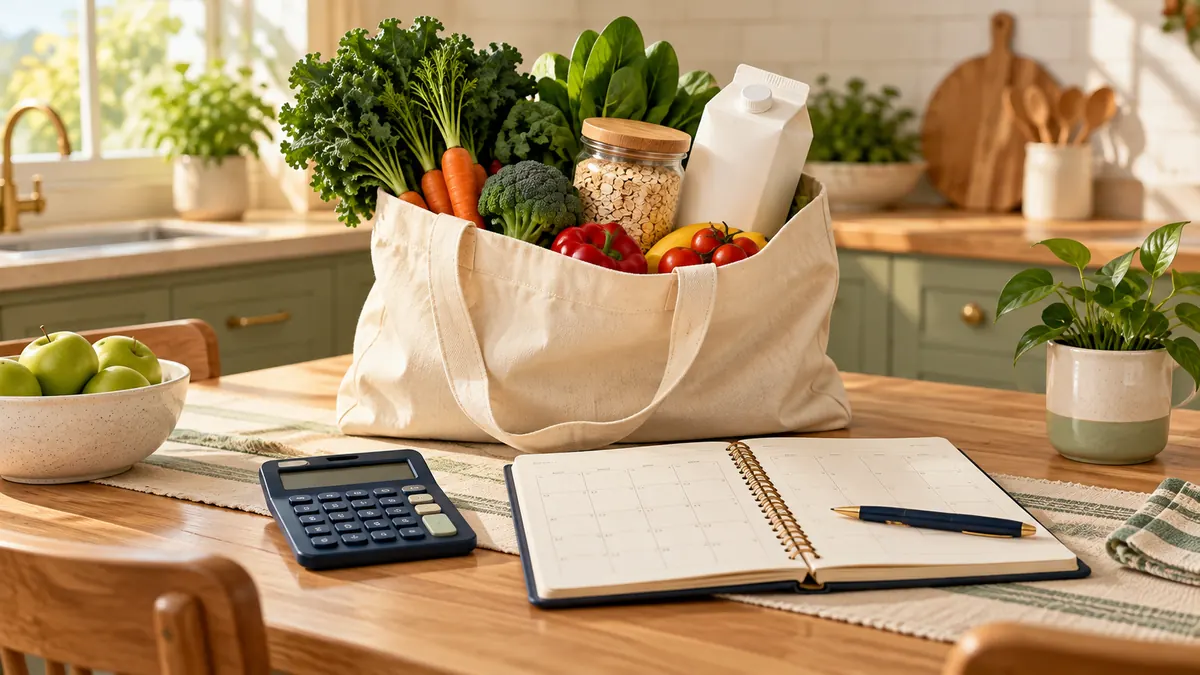
Your monthly grocery budget should reflect the people you feed, the meals you prepare at home, local prices, and the money available after other essential bills. Start with actual food receipts, compare a USDA Food Plan benchmark for your household, and test a realistic target for one month. There is no single dollar amount or income percentage that works for everyone.
This guide includes a copyable two-adult budget and hypothetical cash examples. They illustrate the calculation method, not a universal spending target. For an official benchmark, use a dated USDA report and the age and household-size categories that match your household.
Find your answer: calculate your monthly food spending from receipts, compare a dated two-adult USDA example, or copy the monthly shopping worksheet.
How Much Do You Spend on Food a Month? Start with Receipts
Add food purchases across every store and payment method for one complete calendar month. Subtract nonfood items and refunds for food you returned. Then list restaurant meals separately. Do not add a credit card repayment when the original purchases are already counted. Money moved into a grocery savings category is an allocation, not another food purchase.
| Illustrative monthly record | Amount |
|---|---|
| Supermarket receipts | $620 |
| Less toiletries and cleaning products | −$75 |
| Less refund for returned food | −$15 |
| Food-at-home purchases | $530 |
| Restaurant and takeout spending | $120 |
| Total food spending | $650 |
For this hypothetical example, assume no separate fees or taxes and no other food purchases. The food-at-home total is $620 − $75 − $15 = $530; combined food spending is $530 + $120 = $650. Only the food-at-home amount belongs beside a USDA food-at-home reference. For two adults sharing all these purchases equally, $530 ÷ 2 = $265 per adult is a bookkeeping split, not a dietary allowance or a USDA one-person estimate.
To choose a next-month target, compare more than one complete month when possible and note changes in meals at home. If records are incomplete, label the result an estimate. Keep nonfood supermarket costs in your toiletries and household supplies budget.
Define what your grocery budget includes
Use a food-at-home category for ingredients, snacks, and beverages intended for meals at home. Keep restaurant meals, takeout, and delivery in a separate dining category. Put cleaning supplies, toiletries, pet food, and other nonfood purchases in their own categories even when they appear on a supermarket receipt.
Decide where grocery delivery fees, tips, and applicable checkout taxes belong. You can include them in the grocery cash budget or track them separately, but use the same method every month. A $110 store receipt containing $25 of detergent and shampoo represents $85 of food before any other adjustments—not $110 of groceries.
This distinction matters when evaluating a change. Spending $40 more on food at home while spending $90 less on takeout lowers combined food spending by $50. Looking only at the grocery category would miss that improvement. Track both categories before deciding whether your food budget is getting better or worse.
Use a Dated USDA Food Plan as a Reference
USDA publishes modeled food plans for meals and snacks prepared at home. They are reference plans, not surveys of your household spending. Check the report month, household composition and geographic coverage before comparing its figures with your receipts.
The household-size method is documented in the March 2026 USDA Food Plans report: sum the relevant individual monthly amounts, then add 20% for one person, add 10% for two, or make no adjustment for four. That report is a dated methodology reference, not a current-price quote. Use the report’s other adjustments for other household sizes.
Do not simply divide a four-person family total by four. Different ages, household sizes and dietary needs affect the comparison. A benchmark is a starting question, not proof that spending above it is wasteful or spending below it covers adequate meals.
Monthly Food Budget for Two: A Dated USDA Calculation
For one female and one male adult, both ages 19–50, the March 2026 USDA report gives the following monthly reference costs. Add their individual figures, then apply the report’s 10% two-person adjustment. These are modeled food-at-home costs, not observed average spending, current local quotes, or amounts that include restaurants and household supplies.
| March 2026 plan | Individual amounts combined | Two-person total after × 1.10 |
|---|---|---|
| Low-Cost | $271.20 + $312.20 | $641.74 |
| Moderate-Cost | $330.70 + $391.60 | $794.53 |
| Liberal | $421.50 + $478.10 | $989.56 |
These totals are our arithmetic from the report’s rounded monthly inputs. Use the age-sex categories matching your household and a more recent report when available. The separate $630 worksheet below is a hypothetical allocation exercise; it is not one of these USDA totals.
A Grocery Budget for Two: Copyable Monthly Plan
For two adults, start by listing meals eaten at home and separating food from household supplies. The example below uses a hypothetical $630 cash target to show allocation only; it is not a priced meal plan or a guarantee of nutritional adequacy. The target and weekly split are illustrative, not USDA price estimates.
| Shopping allocation | Example | Your plan |
|---|---|---|
| Week 1 purchases | $140 | $____ |
| Week 2 purchases | $140 | $____ |
| Week 3 purchases | $140 | $____ |
| Week 4 purchases | $140 | $____ |
| Remaining days and buffer | $70 | $____ |
| Monthly total | $630 | $____ |
The first four weeks total $560, leaving $70 for remaining days or price changes. If this month has five shopping trips, another option is $630 ÷ 5 = $126 per trip on average. These are alternative ways to divide the same money; do not add them together. Deduct any fees or taxes included in your target before allocating food purchases.
At checkout, record food $____, nonfood $____ and dining $____ separately. Review the combined food total before calling a smaller grocery bill a saving. Transfer only a verified surplus to your monthly savings goal, after checking the remaining shopping calendar.
Build your own monthly grocery formula
Monthly grocery cash target = expected food-at-home purchases + applicable taxes and shopping costs + planned pantry restocking + a chosen buffer. Keep dining and nonfood purchases outside this formula unless you deliberately label the result a broader food-and-household budget.
Use receipts to estimate ordinary purchases, then identify expenses that will not repeat each week. For an entirely hypothetical month, assume $480 of regular food purchases, $30 of pantry restocking, $20 of applicable checkout and shopping costs, and a $20 buffer. The target is $550. This is an example of the method, not another USDA estimate.
| Hypothetical component | Monthly amount |
|---|---|
| Regular food purchases | $480 |
| Planned pantry restocking | $30 |
| Applicable tax and shopping costs | $20 |
| Buffer | $20 |
| Total grocery cash target | $550 |
Separate a normal monthly target from a temporary stock-up month. A large purchase may raise this month’s cash outflow while reducing what you buy next month. Record the purchase when you pay for it, and explain the timing rather than counting the same pantry purchase twice.
Translate monthly targets into shopping money
For a weekly planning estimate, multiply the monthly target by 12 and divide by 52. A $550 monthly target becomes about $126.92 per week. Multiplying that weekly estimate by four gives only $507.68, so treating every month as four weeks understates the annual plan.
For the actual shopping calendar, count the trips remaining. If you have $240 left and three planned trips, an $80 average per trip is a useful guide. It is not a command to spend exactly $80 each time. One pantry-heavy trip can be offset by a lighter trip if meals remain covered.
Check the target against take-home income
Grocery share of income = monthly grocery spending ÷ monthly take-home income × 100. Use take-home income consistently. Mixing gross salary with deposited pay makes comparisons misleading. Include all predictable household income available for bills, without treating borrowed money as extra income.
A hypothetical $550 grocery target is 18.3% of $3,000 take-home income, 13.75% of $4,000, or 11% of $5,000. The same food basket produces different percentages. That is why a universal grocery percentage is not a reliable test of whether a household is spending responsibly.
Check the dollars left after housing, transportation, insurance, utilities, minimum debt payments, and other essentials. Suppose take-home income is $4,000 and those commitments total $2,900. A $550 grocery target plus $150 for dining leaves $400 for remaining needs and goals. That is a budget check, not a recommendation to use those amounts.
If necessary food does not fit, review the entire plan. A housing or transportation burden cannot always be solved through a smaller food target. Protect adequate meals and medically necessary dietary requirements. Where needed, explore available food assistance through official programs rather than trying to make an impossible spreadsheet work.
Adjust for your household’s real constraints
Meal coverage and changing schedules
Count who is actually eating at home. Shared custody, school meals, travel, overnight work, and visitors can change purchases. Avoid reducing a benchmark mechanically by the percentage of meals eaten elsewhere: breakfast, lunch, and dinner do not necessarily cost the same, and package sizes do not shrink neatly.
Instead, write a simple coverage note: weekday breakfasts for two, packed lunches three days a week, and dinners at home on most nights. Compare receipts with that pattern. Revisit the target if a child begins staying home for summer or an adult starts taking lunch to work.
Dietary needs, access, and time
Allergies, medically prescribed diets, food preferences, cooking equipment, storage, and access to transportation can affect a workable target. Price the foods you can actually buy and prepare. A distant store with lower shelf prices may not be cheaper after travel or delivery costs.
Time is a constraint too. Someone without reliable cooking facilities or with demanding work hours may need a different mix of foods. If a target depends on cooking every meal from scratch and that never happens, adjust the assumptions. The useful budget is the one your household can carry out.
Track actual spending and revise the target
Review the last two or three complete months if records are available. Remove nonfood items and separate dining. Note unusual guests, holidays, moving expenses, or pantry purchases. For a new household, begin with one month of receipts and a local price check, then replace guesses with actual results.
Consider hypothetical grocery totals of $510, $570, and $540. Their average is $540. If the next month has similar meal coverage and you deliberately choose a $20 buffer, a $560 target is reasonable to test. Neither the average nor the buffer guarantees the final bill.
During the month, keep a running total and compare it with the meals still to cover. At month-end, explain the gap: higher prices, extra people, category errors, or an unrealistic starting estimate. Change one assumption at a time so you know why the revised target works.
For shopping tactics, use our separate guide to saving money on groceries. Place your target in the monthly budget and use the paycheck budgeting guide to make sure shopping money is available between paydays.
Frequently asked questions
Is $300 a month enough for one person?
It may work for some people, but it is not a universal target. Price a realistic food basket locally and check a dated benchmark for your household. Compare your own needs, local checkout costs, and actual meal coverage rather than treating $300 as a nutritional guarantee.
Should groceries and eating out share one budget?
You can set a combined ceiling, but track the two parts separately. Otherwise, cutting groceries while increasing takeout can look like progress even when total food spending rises. Include delivery fees and tips consistently.
Are USDA Food Plans average grocery spending?
No. They are reference food plans at different cost levels. Use them to compare assumptions, then build a household cash budget. They are not a personalized spending limit or a substitute for dietary advice.
How often should I update my grocery budget?
Review actual results monthly, and revisit the assumptions when prices, household members, income, or meal schedules change. Avoid rewriting the plan after every small shopping fluctuation.
What if my food spending is above the benchmark?
Check category definitions and household composition first. Then compare realistic local costs and special needs. Higher spending is a reason to investigate, not proof of waste or poor discipline.
Can I use the same target every month?
A stable contribution can help, but cash spending may vary. Plan for holidays, visitors, and restocking, and carry an affordable cushion. Do not count unused grocery money as savings until upcoming food needs are covered.
Updated November 1, 2026. Educational budgeting information, not personalized financial, medical, or nutrition advice. Dollar examples are hypothetical. The linked March 2026 USDA report documents the household adjustment method and is not presented as current pricing. Use local prices for your own plan.
Leave a Reply