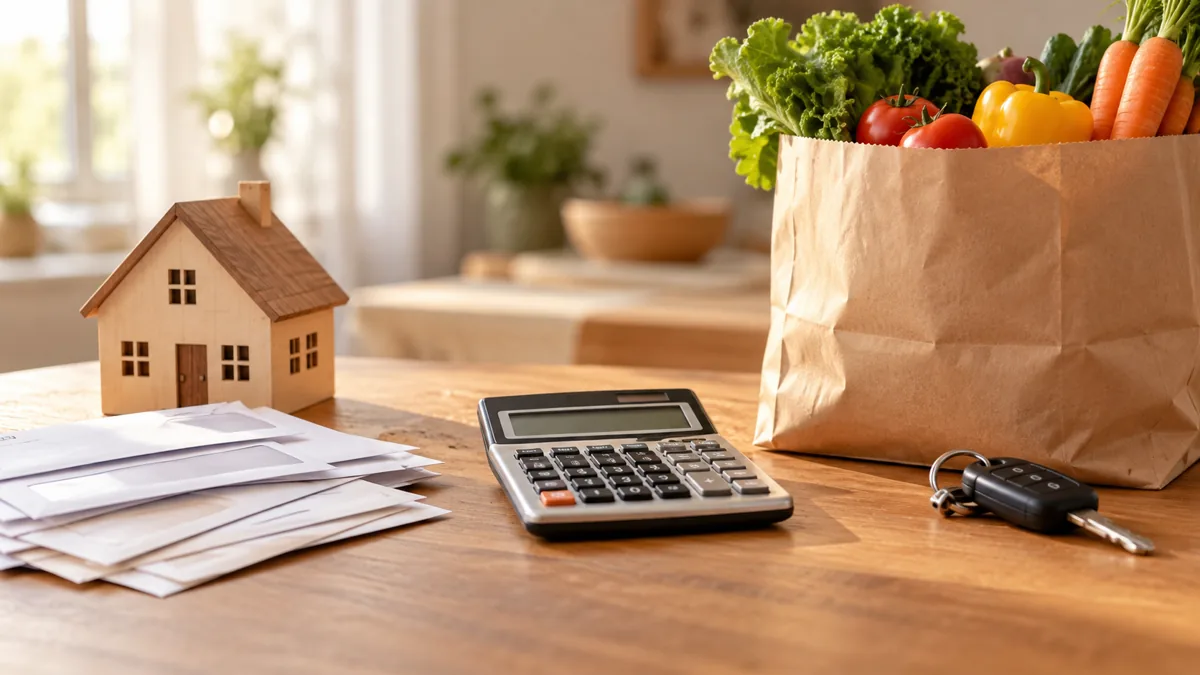
Quick answer: Fixed expenses usually stay similar from one billing period to the next; variable expenses change with use or choices. List fixed bills first, estimate variable spending from recent records, and include irregular costs before deciding what is left to save. The examples below show where common household expenses fit.
What Are Fixed Expenses?
Fixed expenses are costs that generally stay the same from one month to the next.
They’re usually the easiest part of a budget to plan because you already know approximately how much you’ll owe.
Common examples include:
- Rent or mortgage payments
- Car loan payments
- Fixed-rate personal loan payments
- Monthly insurance premiums
- Internet plans with a set monthly price
- Subscription services
Let’s say your rent is $1,400 and your car payment is $350. You know you’ll need at least $1,750 each month to cover those two bills.
That predictability makes fixed expenses easier to schedule, but it doesn’t necessarily make them easy to afford.
In fact, a large fixed expense can put more pressure on your budget than several smaller purchases.
Can Fixed Expenses Change?
Absolutely.
Your rent might increase when you renew your lease. Insurance premiums can change, and subscription companies sometimes raise their prices.
“Fixed” simply means the cost is relatively predictable during the period you’re budgeting for.
It’s still worth reviewing these bills every few months.
What Are Variable Expenses?
Variable expenses change from month to month.
Some depend on how much you use. Others depend on your choices, schedule, or unexpected circumstances.
Examples include:
- Groceries
- Gasoline
- Electricity and water bills
- Restaurant meals
- Entertainment
- Clothing
- Household supplies
- Personal care expenses
Imagine spending $320 on groceries one month and $410 the next.
Nothing unusual necessarily happened. Maybe you hosted family, bought extra household essentials, or simply paid more for the same items.
That’s why variable expenses need a little more breathing room in your budget.
Important: Variable doesn’t mean optional. Groceries and transportation can be essential expenses even though their costs change.
Fixed vs. Variable Expenses: A Simple Comparison
| Fixed Expenses | Variable Expenses |
|---|---|
| Usually predictable | Can change each month |
| Rent or mortgage | Groceries |
| Car loan payment | Gas |
| Fixed monthly insurance premium | Electricity |
| Internet plan | Dining out |
| Monthly subscription | Entertainment |
Neither category is automatically good or bad.
The goal is to understand which costs are predictable and which ones need more flexibility.
A Realistic Monthly Budget Example
Let’s imagine someone brings home $3,800 per month after taxes.
Their expenses might look like this:
| Expense | Monthly Amount | Type |
|---|---|---|
| Rent | $1,300 | Fixed |
| Car payment | $350 | Fixed |
| Insurance | $180 | Fixed |
| Internet and phone | $120 | Fixed |
| Groceries | $450 | Variable |
| Gas | $180 | Variable |
| Utilities | $170 | Variable |
| Dining out | $150 | Variable |
| Entertainment | $100 | Variable |
| Household and personal items | $100 | Variable |
| Savings | $300 | Planned savings |
Total planned expenses and savings: $3,400
Monthly take-home income: $3,800
Money remaining: $400
That $400 isn’t necessarily free spending money. It can provide a cushion for irregular bills, unexpected expenses, or additional savings.
These figures are illustrative, not estimates of what a typical American household spends.
Use Two Labels: Predictability and Necessity
| Expense | Fixed or variable? | Essential or optional? |
|---|---|---|
| Rent during a lease | Usually fixed | Usually essential |
| Groceries | Variable | Essential |
| Streaming subscription | Usually fixed | Optional |
| Electricity | Variable | Usually essential |
| Annual registration | Periodic, often predictable | May be required |
These labels answer different questions. Fixed describes predictability, not importance. Variable describes the amount, not whether you can skip it. Keep a separate due-date column for periodic bills. A credit card minimum can change with its balance and terms; do not assume all minimum payments are fixed.
If electric bills were $90, $100, and $170, the average would be $120. That average is a starting estimate, not a ceiling for a high-usage season. Use seasonal history where available. Put the categories into your monthly plan, then use a paycheck schedule to match due dates.
How to Budget for Fixed and Variable Expenses
1. Start With Your Take-Home Pay
Use the amount that actually reaches your bank account, not your salary before taxes.
If your paycheck varies, look at several recent paychecks and use a cautious estimate rather than assuming every month will be your best month.
If you’re unsure how gross pay differs from take-home pay, read our guide: How Much of Your Paycheck Do You Actually Take Home?
2. Write Down Your Fixed Bills
List the bills you can predict with reasonable accuracy.
Include the payment amount and due date.
This matters because having enough money over the entire month doesn’t always mean you’ll have enough on the day a bill is due.
If rent is due on the first but most of your income arrives later, you may need to set money aside from an earlier paycheck.
3. Look Back at Your Variable Spending
Open your recent bank and credit card statements.
Check what you actually spent on groceries, gas, restaurants, and other changing expenses over the past two or three months.
For example, if your grocery spending was:
- Month 1: $380
- Month 2: $430
- Month 3: $450
Your average was $420 per month.
You might choose a grocery budget of $450 to leave a small cushion.
The right number depends on your household, not on someone else’s budget.
4. Don’t Forget Irregular Expenses
Here’s where many budgets get into trouble.
A car repair, annual membership, holiday gift, or insurance bill might not happen every month, but that doesn’t mean you should ignore it.
Suppose you expect $600 in annual car maintenance.
Setting aside $50 each month gives you a plan for that expense before it arrives.
You can do the same for annual subscriptions, school expenses, and other predictable but infrequent costs.
5. Adjust One Category at a Time
If your expenses are higher than your income, you need to make changes.
Start by looking for expenses you can realistically reduce.
That might mean changing a phone plan, reviewing subscriptions, planning a few lower-cost meals, or reducing restaurant spending.
But don’t assume small purchases are always the main problem.
If housing and transportation consume most of your paycheck, cutting coffee alone probably won’t solve the issue.
Large fixed costs deserve attention too, even if changing them takes more time.
What If Your Variable Expenses Keep Going Over Budget?
First, figure out whether your target is realistic.
If you’ve budgeted $250 for groceries but consistently spend $400, the problem may be the estimate rather than a lack of discipline.
Try these adjustments:
- Track purchases for a few weeks before setting new limits.
- Use a realistic average rather than your cheapest month.
- Give essential categories a small cushion.
- Check spending halfway through the month.
- Move money between categories when necessary instead of abandoning the entire budget.
The Consumer Financial Protection Bureau recommends tracking spending to better understand where your money goes and identify opportunities to adjust it.
A budget should help you make decisions. It shouldn’t make every unexpected expense feel like a personal failure.
Which Expenses Should You Cut First?
There’s no universal answer, but it helps to separate essential needs from optional spending.
Start with expenses that offer little value for the money.
An unused subscription is usually easier to eliminate than a necessary commute.
For larger fixed expenses, compare alternatives before making a decision. Moving to a cheaper apartment or replacing a car may reduce monthly payments, but moving costs, transaction fees, or financing terms could offset the savings.
Look at the total cost, not just the monthly payment.
Make Your Budget Flexible Enough to Last
A useful budget isn’t one where every number stays perfectly on target.
It’s one that helps you cover your bills, prepare for changing costs, and make adjustments before small problems become expensive ones.
Start with your fixed expenses. Estimate your variable expenses using real spending history. Set aside something for irregular bills when possible.
Then check in with your budget regularly.
You don’t need to get everything right in the first month. You just need a clearer picture of where your money is going.
Frequently Asked Questions
Is a grocery bill a fixed or variable expense?
Groceries are generally a variable expense because the amount you spend changes from month to month. They’re still an essential part of most household budgets.
Is rent a fixed expense?
Rent is typically a fixed expense during a lease period because the payment amount is predictable. It may change when the lease is renewed.
Are utility bills fixed or variable?
Utilities are often variable because usage and seasonal conditions affect the bill. Some providers offer budget billing plans that make monthly payments more predictable.
Should I budget for unexpected expenses?
Yes. A small emergency fund can help cover unexpected costs. For irregular but predictable expenses, such as annual insurance or routine car maintenance, consider setting aside money each month.
How often should I review my budget?
A quick weekly check can help you catch overspending early. At the end of each month, compare your planned amounts with what you actually spent and adjust the next month’s budget.
Sources and Further Reading
- Consumer.gov — Making a Budget
- Consumer Financial Protection Bureau — Track Your Spending
- Consumer Financial Protection Bureau — Assess Your Spending
- Federal Reserve Education — Budgeting 101
This article is for general educational purposes and is not individualized financial advice.
Leave a Reply