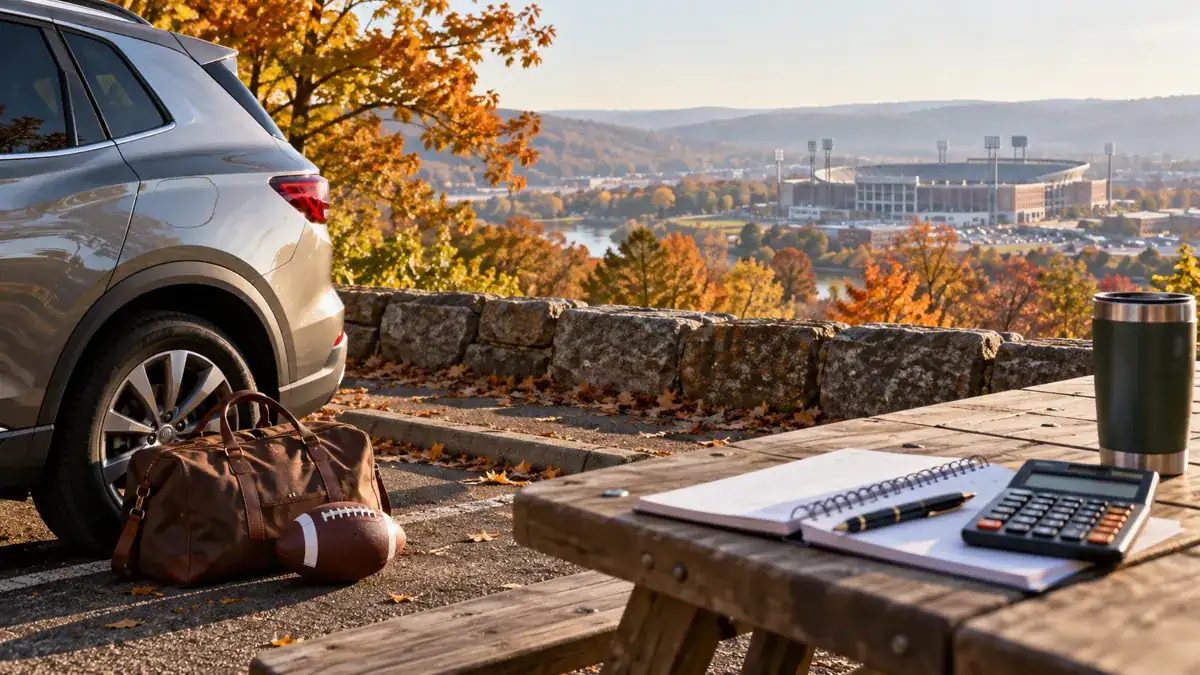
For a college football road trip, compare the whole travel plan before choosing between driving home and booking a hotel. Count round-trip fuel, tolls, parking, meals, the full lodging charge and any extra time away. Then reject any option that depends on driving while too tired. A cheap room can be expensive after fees; a no-hotel plan can be impractical after a late kickoff.
Choose a trip ceiling before buying tickets
Start with the most your household can comfortably spend on the entire weekend. Subtract the final ticket cost, including any seller fees. The remainder is your travel budget. If two tickets cost $200 in a hypothetical $600 trip plan, travel and everything else must fit within $400. A ticket advertised at a low price does not establish that the whole outing is affordable.
Keep money for rent, regular bills and an emergency reserve outside that ceiling. Decide which part of the experience matters most: seeing the game, visiting friends, staying near campus, or sharing a longer weekend. That choice helps you reduce optional costs without removing the reason for going.
Use our monthly budget guide to choose an entertainment limit. If the trip requires advance saving, the savings goal calculator can turn the remaining cost into a monthly target. Do not count uncertain resale proceeds as available cash.
Build two complete travel plans
Do not compare the price of a hotel with fuel alone. Write a same-day plan and an overnight plan with the same number of travelers and the same tickets. Include costs in both plans even when they are identical. That makes the totals understandable while allowing you to isolate what the hotel changes.
The table below is a worked example for two adults sharing one car. Every amount is an assumption, not a live Austin, Oxford, Provo or Orlando quote. The route is an illustrative 360-mile round trip, not a verified route for any particular matchup. Replace it with your actual route and verified checkout prices.
| Expense | Same-day plan | One-night plan |
|---|---|---|
| Two tickets, all-in | $200 | $200 |
| Fuel | $42 | $42 |
| Road tolls | $12 | $12 |
| Game parking | $30 | $30 |
| Meals and snacks | $60 | $90 |
| Hotel, taxes and mandatory fees | $0 | $170 |
| Additional hotel parking | $0 | $20 |
| Planned subtotal | $344 | $564 |
| Unspent contingency reserve | $40 | $40 |
| Total cash to set aside | $384 | $604 |
The overnight plan adds $220: $170 lodging, $20 hotel parking and $30 extra food. The $40 reserve is money available for unexpected needs; it is not automatically an expense. If no unexpected costs occur, actual spending equals the planned subtotal. Recording a reserve as already spent would hide what the trip really cost.
Check the fuel calculation
Fuel cost equals round-trip miles divided by your vehicle’s expected miles per gallon, multiplied by the fuel price per gallon. Here, 360 miles divided by 30 mpg equals 12 gallons. At the assumed $3.50 per gallon, that is $42. Add detours and extra local travel to the route instead of pretending every mile is highway driving.
Fuel is a cash expense, but it is not the entire cost of owning a car. Tire wear, maintenance and depreciation also matter, especially across repeated trips. Keep the immediate travel comparison and your longer-term vehicle budget distinct. Our annual car expense guide explains the separate reserve approach.
Decide whether the return drive is realistic
Estimate the time you would actually leave the stadium area, not just the game’s scheduled start. Add the event itself, the walk to the vehicle, time leaving the lot, a meal stop and the drive home. A kickoff change can affect this plan. Check the official event listing again before a nonrefundable booking becomes final.
A hotel may be the better choice even if it adds money. If the same-day option depends on an exhausted driver, remove it from consideration rather than treating safety as a small surcharge. Consider another rested driver, a shorter future trip, staying with willing friends, or watching locally. Do not assume a late-night rideshare will be available or inexpensive.
If you choose a room, compare cancellation deadlines with the event schedule and your own work commitments. Write down when a refundable reservation becomes nonrefundable. The right comparison is between complete workable options, not an uncomfortable or unsafe itinerary and a convenient one.
Use the host school’s rules, not your own team’s habits
Away fans need the host venue’s parking, ticket and entry instructions. A familiar home-campus rule may not apply elsewhere. Confirm which school is hosting before using a parking map. Texas and Ole Miss references in a search trend do not by themselves establish the venue or date of your next outing.
For a Texas home game, the university’s 2026 football parking page lists public parking locations available for a fee and directs fans to parking purchases. It also describes traffic restrictions and permit-holder relocation rules. Use the relevant current event details; do not assume an ordinary weekday space remains available on game day.
The official Texas football fan guide covers mobile tickets, assigned entry gates and permitted bags. Those are practical preparation checks that can prevent wasted walking, storage expenses or missed entry. For another venue, find that institution’s equivalent guide rather than applying Texas rules universally.
Separate game parking from overnight parking
Ask whether a game parking pass allows overnight storage and whether a hotel charges for each night or calendar day. A hotel room near campus does not automatically include stadium parking. Conversely, a distant hotel may require a separate transfer to the venue. Write both charges into the plan if both are necessary.
Location also has a time cost. A cheaper room 25 miles away may add fuel, tolls and morning travel. Compare the total difference, not just the nightly rate. If you have accessibility needs, verify the actual route, drop-off arrangements and appropriate parking with the venue before booking.
Share costs without confusing household totals
If two adults split the example’s $344 same-day subtotal equally, each pays $172. The $564 overnight subtotal becomes $282 each. Those amounts include one ticket per person because tickets were included in the original group totals. Do not divide shared expenses and then accidentally charge each person for both tickets again.
For unequal arrangements, agree on the allocation before someone books everything. One person might pay fuel while another pays lodging, but compare those contributions to the agreed shares afterward. Make clear whether a friend’s cancellation changes the amount everyone else owes and who absorbs a nonrefundable room charge.
Groups can reduce the per-person cost of a room or vehicle, but occupancy limits, additional-person fees and seat capacity still apply. Do not price a four-person plan using a two-person quote without checking the full booking. Keep a simple list of paid amounts, remaining balances and refund deadlines.
Check the checkout total before committing
Collect ticket and lodging quotes for the correct event dates and number of people. Include taxes, mandatory charges and parking. Record what is refundable and when. If you change one large component, recalculate the whole plan: a cheaper ticket on a different day does not help if it creates another hotel night.
In the example, the overnight cash target exceeds a $600 ceiling by $4. That small gap could be addressed by a verified lower meal cost, a genuinely cheaper booking or a slightly different plan. It does not justify assuming taxes will disappear or using the reserve to conceal a predictable expense.
After the trip, compare actual costs with the worksheet. Save the useful lessons: fuel accuracy, meal spending, parking logistics and whether the hotel was worth its additional cost. A personal record is more useful for your next trip than another fan’s unsupported claim that every game weekend costs the same amount.
Frequently asked questions
Is driving home always the cheapest choice?
It can avoid lodging, but only compare workable plans. Late travel, extra stops or an unsuitable return drive can change the decision. If the itinerary requires tired driving, choose a safer plan or postpone the trip.
Are the prices in this article actual game-day quotes?
No. They are explicitly labeled assumptions for demonstrating the calculation. Use live all-in ticket, parking and lodging prices for the host venue and exact dates before buying anything.
Should I divide every expense by the group size?
Divide genuinely shared costs according to your agreement. Tickets and personal purchases may be individual expenses. Keep the household or group total visible so expenses are neither omitted nor counted twice.
Does a college football ticket include parking?
Do not assume it does. Read the specific ticket package and parking offer. Some parking is separately reserved, and access may depend on a particular lot, entry route or permit.
What if kickoff time changes?
Recheck the official schedule and update your return-drive and lodging plans. Refund eligibility depends on the seller’s terms. A schedule change does not automatically guarantee a hotel or ticket refund.
Editorial note: Prepared October 25, 2026. This is an independent travel-budget worksheet, not an official team announcement or ticket offer. Examples do not represent average market prices.
Leave a Reply