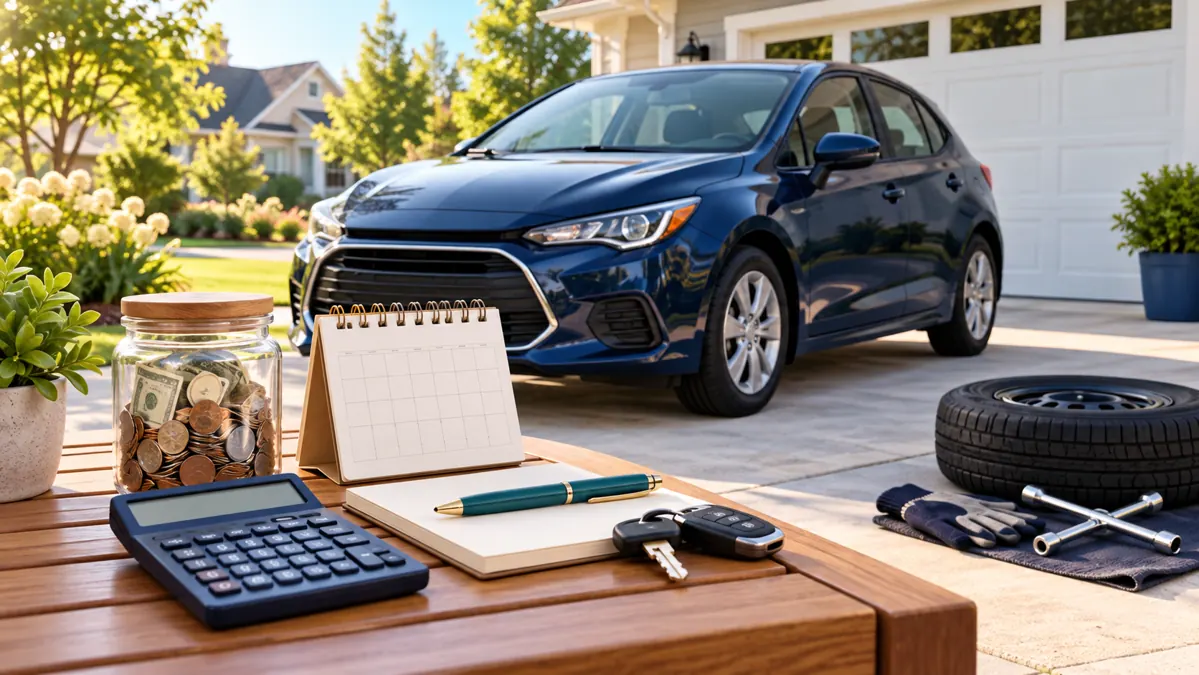
To budget for car expenses that do not arrive every month, list the bills you expect over the next year, estimate each amount, and divide the total by 12. Transfer that amount into a dedicated car sinking fund. Then check each due date: dividing by 12 will not fully fund a bill that is due next month.
For example, $3,000 of planned annual car costs requires $250 per month when you have a full year to save and no starting balance. The examples below show how to handle insurance renewals, registration, maintenance, tires, and a repair allowance without counting the same expense twice.
What Is a Car Sinking Fund?
A sinking fund is money gradually set aside for a particular future expense. Your car fund can cover periodic bills and costs you can reasonably anticipate, even when the exact amount is uncertain. It is an allocation within your savings, not a special investment product.
Keep loan payments, gasoline or charging, regular parking, and other ordinary monthly spending in your normal budget. Use the sinking fund for items such as a six-month insurance premium, an annual registration renewal, or tires you expect to replace. Our fixed versus variable expenses guide explains why predictable timing and essential spending are different labels.
Step 1: List Your Periodic Car Expenses
Gather renewal notices, insurance documents, service invoices, your owner’s manual, current mileage, and any written repair estimates. The CFPB spending review recommends examining past transactions and including less frequent expenses. Its guidance appears in a homebuying context; the budgeting principle is useful here too.
Insurance Renewals
Record the premium, policy period, due date, and payment arrangement. Two six-month premiums of $750 would total $1,500 for a year if the price stays unchanged. That is an assumption, not a promise about your next renewal. Use the latest notice and update the plan when the insurer provides a new quote.
If you already pay insurance monthly from checking, either keep it there or move the whole payment into this system. Do not budget the monthly premium and a second annual insurance reserve for the same bill. NAIC’s auto insurance resources can help with coverage questions and finding state insurance assistance. Compare equivalent coverage and deductibles when shopping.
Registration, Vehicle Taxes, and Inspections
Use your actual renewal notice or the official agency’s estimate. Registration fees, applicable vehicle taxes, emissions tests, safety inspections, and renewal schedules vary by location and vehicle. Not every driver owes every item. Find the appropriate agency through USAGov’s state motor vehicle services directory. Avoid treating another state’s fee as your own.
Scheduled Maintenance
Plan services that are likely to fall within your next 12 months of driving. Mileage and elapsed time both matter. The FTC recommends following the manufacturer’s maintenance schedule for your driving conditions and asking shops to explain additional recommendations. Request itemized estimates so labor, parts, taxes, and diagnostic charges are not surprises.
Tires and Repair Allowances
Get a tire quote that states what is included, such as installation, balancing, disposal, and taxes. Use condition, manufacturer guidance, and professional assessment to plan replacement; do not assume every driver needs a new set annually. NHTSA’s tire guidance explains pressure, tread, maintenance, and aging. A savings deadline must never become a reason to keep driving on unsafe tires.
A repair allowance is different from a known repair quote. Review the vehicle’s history and upcoming needs to choose a planning amount. It may prove too small or go unused. Keep known work, routine service, tire replacement, and the allowance distinct so the same repair is not included in multiple categories.
Step 2: Divide Your Annual Plan by 12
Steady monthly contribution = planned annual sinking fund total ÷ 12. This is a full-cycle planning formula. It assumes contributions arrive before the related withdrawals, costs match your assumptions, and you are not starting partway through an underfunded cycle.
The following amounts are invented examples for one vehicle, not national averages, recommended budgets, insurance quotes, or state fee schedules. The tire line is this household’s annual allocation toward a future replacement; it does not assume a purchase every year. Fuel, loan payments, depreciation, and routine monthly parking are excluded.
| Annual planning item | Hypothetical amount |
|---|---|
| Insurance renewals | $1,500 |
| Registration, applicable taxes, and inspections | $180 |
| Scheduled maintenance | $360 |
| Tire replacement allocation | $360 |
| Additional repair allowance | $600 |
| Total | $3,000 |
The total is $1,500 + $180 + $360 + $360 + $600 = $3,000. Dividing by 12 gives $250 per month. The monthly category allocations are $125, $15, $30, $30, and $50 respectively. Together they also total $250.
Compare Different Annual Plans
| Annual plan | Monthly contribution |
|---|---|
| $1,800 | $150 |
| $3,000 | $250 |
| $4,800 | $400 |
These are arithmetic comparisons, not labels for cheap, average, or expensive cars. A newer car can have high insurance costs, while an older paid-off car can have substantial repair needs. Replace the example with your vehicle, location, mileage, and payment schedule.
Step 3: Check What Is Due Before You Have Saved Enough
An annual average can hide a near-term shortage. Suppose a $750 insurance renewal is due after three monthly deposits, and you already have $150 reserved specifically for it. The required deposit is ($750 − $150) ÷ 3 = $200 per month. Saving the steady-cycle $125 insurance allocation for three months would leave only $525 including the starting money: a $225 shortfall.
If the other categories still need their combined $125 monthly allocation, the temporary total is $325 per month: $200 for insurance plus $125 for everything else. This works only if those other due dates also have adequate funding. Check each category rather than assuming a large combined balance solves every upcoming bill.
After paying the renewal, if the next $750 bill is six months away and no insurance money remains, $125 per month rebuilds that portion. Recalculate when prices or dates change. If a bill is due before your next deposit, a future transfer cannot cover it; review current available cash and contact the provider about permitted payment options before the deadline.
Step 4: Build the Transfer Into Your Budget
Give the fund its own line in your monthly budget. A hypothetical household taking home $3,500 and allocating $3,100 to other spending and required payments has $400 left. A $250 car-fund transfer leaves $150 for its other goals; the temporary $325 catch-up plan leaves $75. Neither allocation is affordable if the original spending estimate is incomplete.
Match transfers to your actual pay schedule and keep enough checking cash for bills. The $3,000 annual plan equals $125 across 24 twice-monthly paychecks. Across 26 biweekly paychecks it is about $115.39 per paycheck when rounded up; 26 deposits total $3,000.14. Some calendar years or personal schedules differ, so count your deposits rather than assuming a fixed number.
Keep money needed soon accessible and stable, and compare account fees, transfer timing, and applicable deposit insurance. One savings account with a category ledger can work; separate accounts are optional. An automatic transfer is helpful only when your checking balance can support it without missed payments or overdrafts.
Step 5: Track Withdrawals and Recalculate
Use a simple ledger: ending fund balance = opening balance + contributions − car costs paid from the fund. With $500 initially, three $250 deposits, and a $180 registration payment, the balance becomes $1,070. That balance is reserved for future car bills, not automatically available for discretionary spending.
Record the expense once when you pay the provider, then reduce the reserved balance. The transfer from checking to savings is not a second purchase. If you pay by credit card, preserve enough fund money for that charge and track the later card payment without treating it as another repair expense. Review the ledger monthly and after a renewal, large repair, or change in driving.
A Car Fund and an Emergency Fund Have Different Jobs
Registration and a known tire replacement are planned costs. A sudden necessary breakdown may exceed your repair allowance and require a separate emergency reserve. Our emergency fund guide covers that broader protection; this article organizes vehicle bills and due dates. Do not count the same savings balance as fully available for both purposes.
If the planned transfer is unaffordable, identify the shortfall openly. Compare quotes and payment terms, reduce optional driving costs where practical, or extend a nonurgent savings goal. Do not skip required coverage, registration obligations, or necessary safety work just to make the spreadsheet balance. A budget cannot guarantee that every repair becomes affordable.
Frequently Asked Questions
How much should I save for car expenses each month?
Add your own expected periodic costs and divide by 12 for a full-year starting point. Then adjust for existing category balances and the deposits remaining before each bill. There is no universal dollar amount that fits every vehicle.
Should gasoline and my car payment go in this fund?
Usually keep ordinary monthly costs in the regular budget and periodic costs in the fund. You can use another system, but classify each payment once and make the total transportation budget visible.
What if I already pay insurance monthly?
Keep those payments in the regular budget unless you deliberately change the system. Exclude the same premiums from the annual fund calculation to avoid double counting, and check any installment fees in your actual agreement.
Do I need to buy tires every year?
No. An annual allocation can build money toward a later purchase. Actual replacement depends on condition, use, age, and manufacturer guidance. Ask a qualified professional about safety rather than relying on a calendar-based savings assumption.
Can the fund pay for an unexpected repair?
Yes, if you have allocated repair money, but check what remains for imminent renewals and maintenance. If the repair exceeds available funds, assess other resources separately and rebuild the plan after the payment.
Should unused money be spent at year-end?
No. Rolling it forward can help with uneven costs or a future tire purchase. Review whether the target remains appropriate and distinguish money committed to upcoming bills from any genuine surplus.
Your Next Step
Collect your next insurance renewal, registration notice, and maintenance estimates. Write each due date beside its amount, calculate the steady annual contribution, and correct any near-term funding gap. Start with a transfer you can support, track the balance, and update the plan when the real numbers change.
Sources and Planning Assumptions
CFPB — Assess your spending
NAIC — Consumer auto insurance resources
USAGov — State motor vehicle services
FTC — Auto Repair Basics
NHTSA — Tires
Reviewed October 17, 2026. All cost and household examples are hypothetical and exclude interest and unlisted costs. This is a cash-flow planning guide, not a complete estimate of vehicle ownership costs or personalized financial, insurance, legal, or mechanical advice. Confirm current terms with your insurer, state agency, manufacturer, and qualified service provider.
Leave a Reply