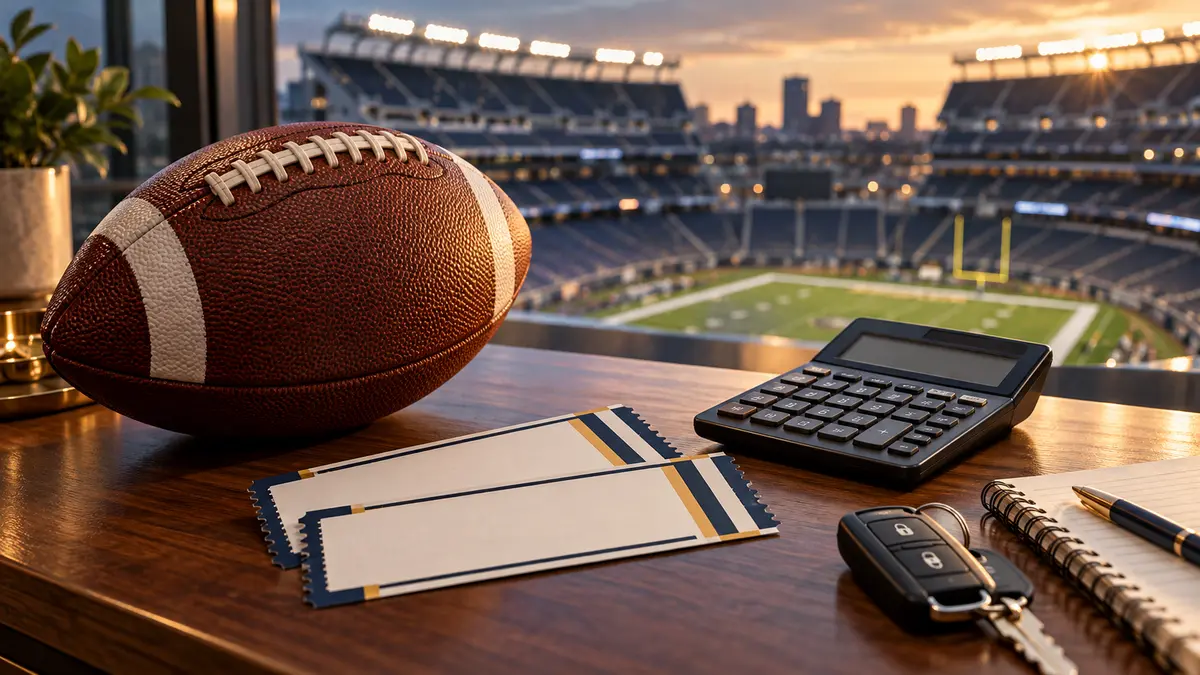
A $150 NFL ticket can become a $250 outing once you add transportation, food, and the costs of getting everyone there. Before buying seats, build a complete game-day budget and divide the total by the number of people attending. The useful comparison is the entire experience you can afford, including the trip home.
Start with a total spending limit
Choose a maximum amount before opening a ticket marketplace. Include the money you can spend without delaying essential bills or drawing down cash reserved for emergencies. Write the number at the top of a note and share it with everyone attending. This makes it easier to compare seats without quietly expanding the budget every time a better section appears.
For example, two friends might agree on a $400 total outing. That does not mean they can each buy a $200 ticket. If they expect $60 for transportation, $40 for food, and a $20 contingency, only $280 remains for admission, or $140 per person. Starting with the full limit produces a usable ticket ceiling.
Use our monthly budget guide to place entertainment alongside your regular commitments. A rare experience can deserve a generous allocation; it still needs a named source of cash.
Calculate the all-in cost of going to an NFL game
Use this worksheet before comparing listings. Every dollar amount below is hypothetical and is not a quote for a Patriots game, Bears game, stadium, or ticket seller. Replace each line with the actual price for your chosen date and location.
| Expense for two adults | Example amount | What to verify |
|---|---|---|
| Admission, including mandatory seller fees | $280 | Two equivalent seats, exact event |
| Parking or public transport | $45 | Round trip, booking and exit arrangements |
| Food and nonalcoholic drinks | $40 | Allowed items and realistic meal timing |
| Fuel or additional travel | $20 | Only costs not already counted above |
| Contingency | $15 | Small unexpected expenses |
| Total | $400 | $200 per attendee |
The basic formula is admission plus transportation plus food plus lodging, if needed, plus other planned purchases and a contingency. Divide by attendees to understand each person’s share. Keep shared costs separate from individual purchases so a group member who skips merchandise does not unknowingly subsidize everyone else’s souvenirs.
Compare equivalent tickets
Check section, row, number of seats together, obstructed views, accessibility details, and delivery method. Two listings with similar prices may provide different experiences. A cheaper single seat is not a valid comparison with a pair of adjacent seats when attending together is part of the plan.
Record the final purchase amount before submitting payment. The FTC’s ticket-pricing guidance says covered sellers must display mandatory charges upfront, subject to limited exclusions such as certain taxes or optional extras. Upfront disclosure makes comparisons easier; it does not establish that a price is affordable or that every listing offers the same protections.
Parking versus transit: include the return trip
Price both directions of the journey. A rail ticket that looks inexpensive on the way in may require an expensive alternative after the game if service ends early or the group misses the last departure. Look up the actual operating schedule for the event date, including any special service notices, before committing to tickets.
When driving, include the parking location, the walking distance, and whether a parking reservation has its own conditions. Avoid counting the same cost twice: if a friend quotes a single amount covering fuel and parking, do not add those items again elsewhere in the worksheet. State what the shared amount covers.
A rideshare estimate seen hours before kickoff may not be a dependable return quote. Set a maximum you are willing to pay and identify an alternative meeting point or transport plan. The budget should survive a longer-than-expected exit without requiring everyone to make a hurried financial decision in a crowd.
Food, bags, and merchandise need a separate decision
Check the stadium’s current entry and bag policies directly. This is particularly useful when a group plans to bring items to reduce spending. A homemade meal is not a saving if the relevant policy prevents it from entering and you then have to buy another meal. Policies differ by venue and may change.
Agree on a food allowance rather than treating every purchase as an exception. One person may want a full meal, while another prefers eating beforehand. Keep those choices individual where possible. A simple note saying “ticket and travel shared; food paid separately” can prevent disagreement after the event.
Merchandise deserves its own ceiling. If the goal is to remember the trip, choose the maximum souvenir amount in advance and allow yourself to spend less. A jersey purchase is optional even when the game feels special. Include shipping or later online purchases if you intend to order something after returning home.
For an overnight trip, compare two complete plans
When travel requires a hotel, add the room total, parking, meals outside the stadium, and the cost of getting between the hotel and the venue. Check cancellation deadlines and whether the booking matches the actual event schedule. A cheaper room farther away may create a larger transport bill.
Build two columns: a day trip and an overnight trip. Keep the ticket assumptions identical so the comparison isolates the travel choice. If the day trip is exhausting or impractical, it may not be a meaningful option, even if it looks cheaper. Money is one constraint; time and comfort affect what you receive for it.
Do not count a hotel reward or credit until you have checked eligibility, availability, and restrictions for that booking. Likewise, a possible resale of unwanted tickets should not be treated as guaranteed cash. Start with the amount you would still owe if those hoped-for offsets never arrive.
Decide how much a better seat is worth
Suppose the complete outing costs $400 with one pair of seats and $500 with another. The upgrade costs $100 for the group, or $50 each. Ask what that extra amount buys: a better view, less walking, a covered area, or simply a different section number. Describe the benefit in concrete terms.
You can set a maximum upgrade price before browsing. For instance, a group may allow up to $25 extra per person for an agreed accessibility or comfort benefit but nothing extra for location alone. This turns an emotional bidding process into a decision everyone understands.
Compare the upgrade with other uses of the same cash. Would it replace another outing, delay a savings goal, or simply come from money already reserved for entertainment? Our savings goal calculator can show how a planned event changes the monthly amount needed for a separate goal.
Use a group payment plan before checkout
Decide who purchases, when the other attendees reimburse them, and how a cancellation will be handled. The person buying the tickets should be comfortable carrying the full charge if someone pays late. A promise to reimburse later does not reduce the balance due on the purchaser’s account today.
Review the seller’s actual delivery, transfer, refund, and cancellation conditions. Save the order confirmation and event details. Use the team’s or venue’s official site to reach a ticketing route rather than assuming that a social-media message or a low advertised price establishes legitimacy.
If the total no longer fits, compare a lower-cost date, fewer optional purchases, or another way of enjoying the sport. A purchase deadline should not erase the spending limit established at the beginning. You can value the experience highly and still decide that this particular offer is too expensive.
A five-minute check before you buy
- Confirm the exact teams, date, venue, and seat details.
- Record the full admission amount and compare equivalent listings.
- Add round-trip transport, food, lodging, and optional purchases.
- Agree on each attendee’s share and reimbursement timing.
- Check cancellation, delivery, entry, and payment conditions.
- Compare the final total with the original spending limit.
Keep the worksheet after the event and enter actual spending. The difference between the estimate and reality tells you what to adjust next time. If transportation cost more but food cost less, preserve both details rather than remembering only that the outing “roughly worked.” This small record can make the next decision faster.
Frequently asked questions
How much does it cost to attend an NFL game?
There is no useful universal total. Add the exact ticket purchase amount to your own travel, meals, lodging, and optional spending. The $400 example above is a planning exercise, not a current market average.
Should I compare the advertised ticket price or checkout total?
Compare equivalent seats using the total you will actually pay. Read the seller’s disclosures and include any remaining taxes or optional selections before deciding.
Is driving always cheaper for a group?
No. Compare fuel, parking, tolls where applicable, and the practical return journey with transit or other options. Split shared costs by the actual number of people paying.
Does a cheaper seat automatically make the trip affordable?
No. Travel and lodging can exceed the admission saving. Recalculate the whole outing whenever the date, venue, or group size changes.
How far ahead should I save?
Divide the amount still needed by the number of saving periods before purchase. Keep that plan separate from emergency savings and revisit it if actual quotes change.
Reviewed October 23, 2026. Independent budgeting guide; no affiliation with the NFL, teams, venues, or ticket sellers. Representative image is an illustrative original image.
Leave a Reply